

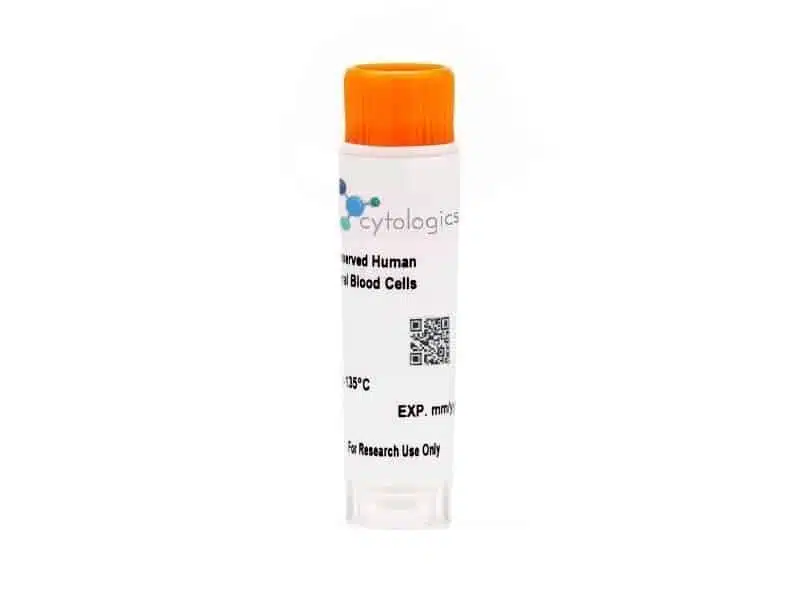
Human Irradiated Peripheral Blood Mononuclear Cells
Human Irradiated Peripheral Blood Mononuclear Cells (PBMCs) are cryopreserved immune cells isolated from healthy donor peripheral blood and treated with a controlled irradiation process that permanently prevents cell proliferation while preserving their ability to participate in immune signaling and cell-to-cell interactions. Because these cells no longer divide, researchers can use them as supportive immune cells without the risk of unwanted expansion during culture.
Irradiated PBMCs are widely used in immunology, oncology, and cell therapy research where metabolically active, non-proliferating immune cells are required. They are particularly valuable as feeder cells for T cell and NK cell expansion, stimulator cells in mixed lymphocyte reaction (MLR) assays, antigen presentation studies, cytokine secretion experiments, and immune activation assays. By providing a ready-to-use, cryopreserved product, Cytologics enables researchers to eliminate the time, equipment, and variability associated with performing PBMC isolation and irradiation in-house.
Product Features
- Healthy donor-derived Peripheral Blood Mononuclear Cells (PBMCs)
- Cryopreserved and ready to use upon thaw
- Validated irradiation process permanently prevents cellular proliferation
- High post-thaw viability with preserved immune function
- Ideal for feeder cell, antigen presentation, and immune stimulation assays
- Available from individual donors or custom donor selections
- Manufactured under rigorous quality control standards
- Research Use Only (RUO)
Applications of Human Irradiated PBMCs
Unlike standard PBMCs, irradiated PBMCs retain short-term biological activity but lose the ability to replicate or divide in culture. This allows investigators to study immune responses while preventing feeder cells or accessory cells from overgrowing experimental cultures.
Human Irradiated PBMCs are commonly used for:
- T cell expansion protocols
- NK cell expansion workflows
- Mixed lymphocyte reaction (MLR) assays
- Feeder cell preparation
- Antigen presentation studies
- Antigen-specific T cell stimulation
- Cytokine release assays
- Immune checkpoint studies
- Adoptive cell therapy research
- CAR-T and CAR-NK cell manufacturing research
- Drug discovery and cancer immunology
- Vaccine development
- Transplant immunology
- Functional immune cell assays
How Human Irradiated PBMCs Are Manufactured
Human Irradiated PBMCs are isolated from fresh peripheral blood obtained from consented healthy donors at an FDA-registered collection site. Peripheral Blood Mononuclear Cells are separated using density gradient centrifugation to recover lymphocytes (T cells, B cells, and NK cells) together with monocytes while removing granulocytes, erythrocytes, and platelets.
Following isolation, the PBMCs are exposed to a validated irradiation process that permanently inhibits cellular proliferation while maintaining viability and functional immune activity immediately following thaw. The cells are then cryopreserved using an optimized cryoprotectant formulation and stored in the vapor phase of liquid nitrogen until shipment.
Each lot undergoes quality control testing for cell count, viability, and purity prior to release. Donors are screened in accordance with applicable FDA regulations for donor eligibility. Cytologics Human Irradiated PBMCs are supplied exclusively for Research Use Only (RUO).
Frequently Asked Questions
What are Human Irradiated PBMCs?
Human Irradiated Peripheral Blood Mononuclear Cells (PBMCs) are healthy donor-derived immune cells that have undergone a controlled irradiation process to permanently prevent cellular proliferation while maintaining short-term biological activity. These cells remain valuable for immune assays where functional accessory cells are required but cell division is undesirable.
Why are PBMCs irradiated?
Irradiation prevents PBMCs from proliferating during culture while preserving their ability to support immune cell activation, antigen presentation, and cytokine production. This makes irradiated PBMCs ideal as feeder cells and stimulator cells in many immunology workflows.
What is the difference between irradiated and non-irradiated PBMCs?
Standard PBMCs retain the ability to proliferate following activation, whereas irradiated PBMCs have permanently lost this capability. Researchers select irradiated PBMCs when they require immune support functions without introducing proliferating background cells into an experiment.
Can irradiated PBMCs still function after irradiation?
Yes. Although irradiation prevents cell division, irradiated PBMCs retain metabolic activity and continue to participate in immune signaling, cytokine secretion, and antigen presentation for many downstream research applications immediately following thaw.
What research applications use irradiated PBMCs?
Human Irradiated PBMCs are commonly used for feeder cell applications, T cell expansion, NK cell expansion, mixed lymphocyte reaction (MLR) assays, antigen presentation studies, cytokine release assays, vaccine research, immunotherapy development, cancer immunology, transplant immunology, and other functional immune cell assays.
Human Material Precaution
WARNING: HUMAN SOURCE MATERIAL
This product contains human-derived biological material and should be handled using Universal Precautions and appropriate biosafety procedures.
Source donors have tested non-reactive for FDA-required infectious disease markers. However, because no testing methodology can completely eliminate the possibility of infectious agents, all human-derived materials should be considered potentially biohazardous and handled according to institutional biosafety guidelines.
This product is intended For Research Use Only (RUO) and is not intended for use in humans or for therapeutic or diagnostic applications.

